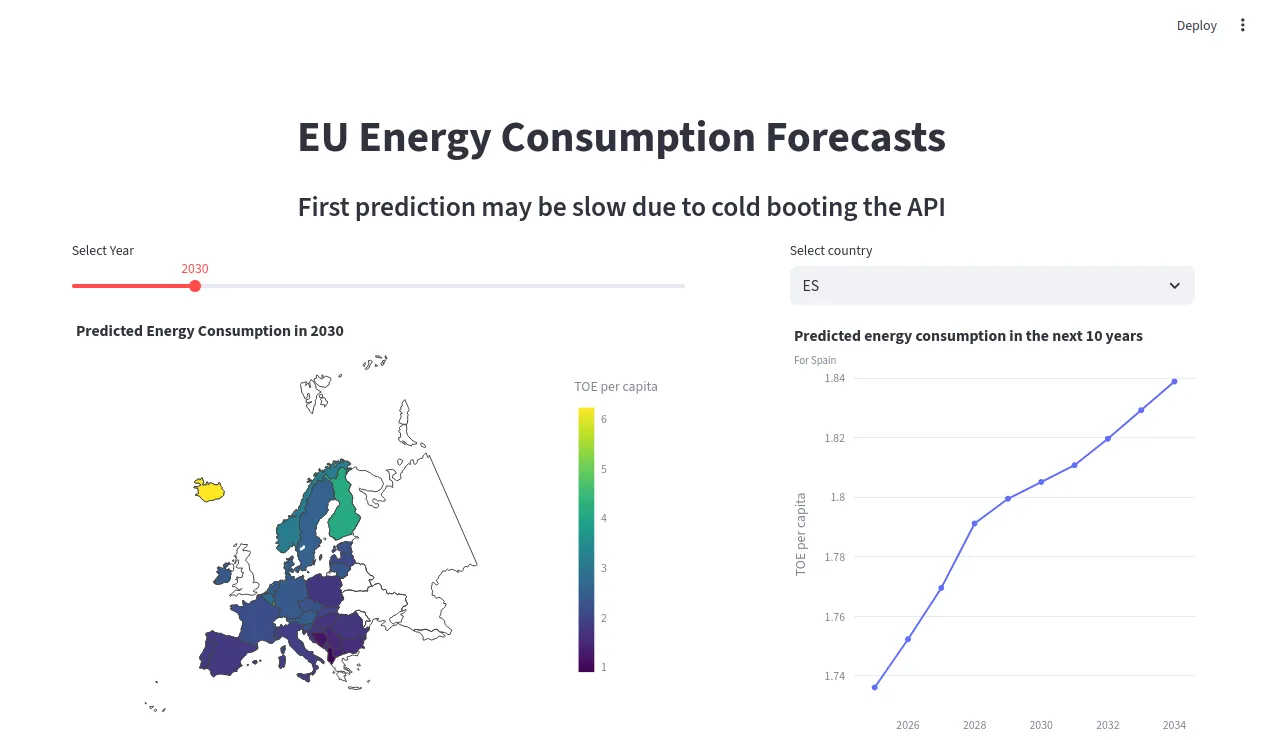
EU energy consumption forecasting
An end-to-end machine learning system, from Spark data processing to a public forecasting app on Google Cloud.
Goal
To show the full lifecycle of a machine learning system rather than to build the best possible forecaster: data processing, training, experiment tracking, packaging, deployment and a public interface.
Pipeline
- Data. Eurostat energy statistics loaded into a Databricks SQL warehouse and preprocessed with PySpark and Pandas.
- Models. PyTorch neural networks and XGBoost regressors, evaluated on temporal splits so the test years always lie in the future, tuned with cross-validation and tracked in MLflow.
- Serving. The selected model is wrapped in a FastAPI service, containerised with Docker and deployed to Google Cloud Run, with Artifact Registry, IAM and Secret Manager configured for it.
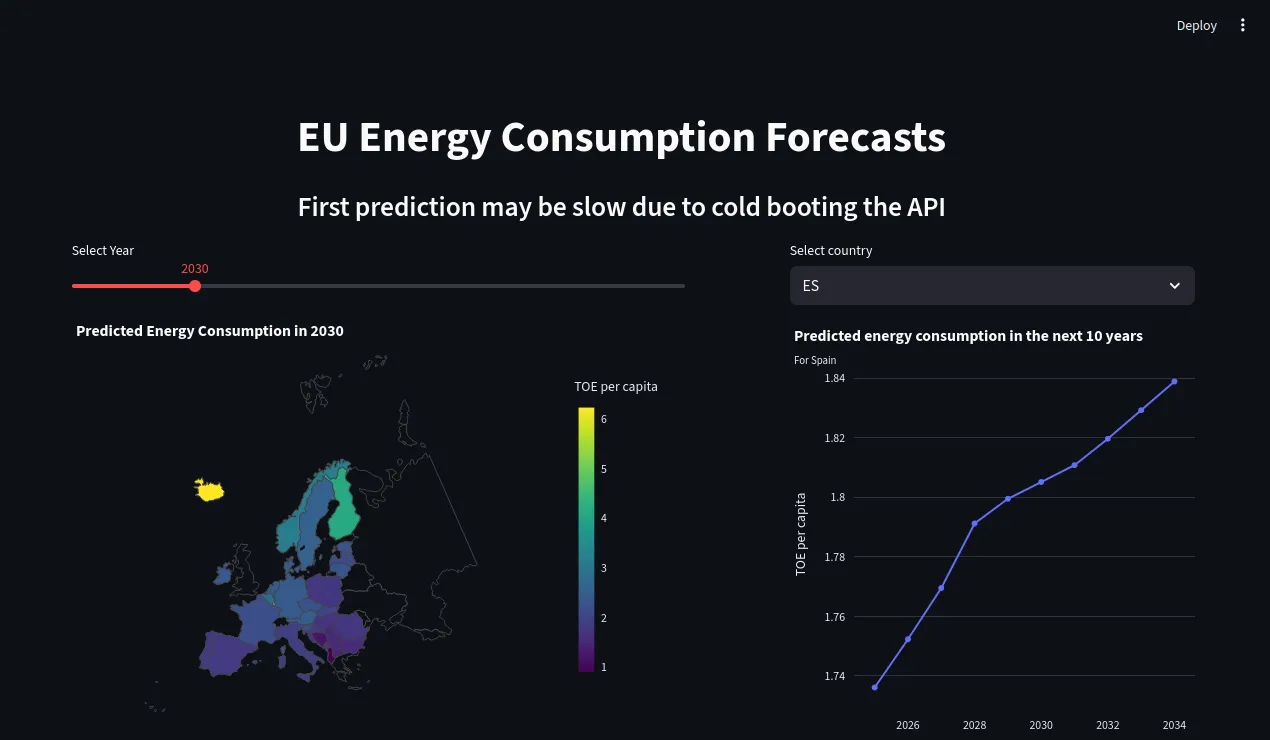
- Interfaces. A Streamlit app queries the API live; a Tableau story presents the exploratory analysis.