MBiCEM: planning on learned models
A trajectory planner that runs iCEM on learned dynamics models and heavily penalises the predictions the model is unsure about.
Approach
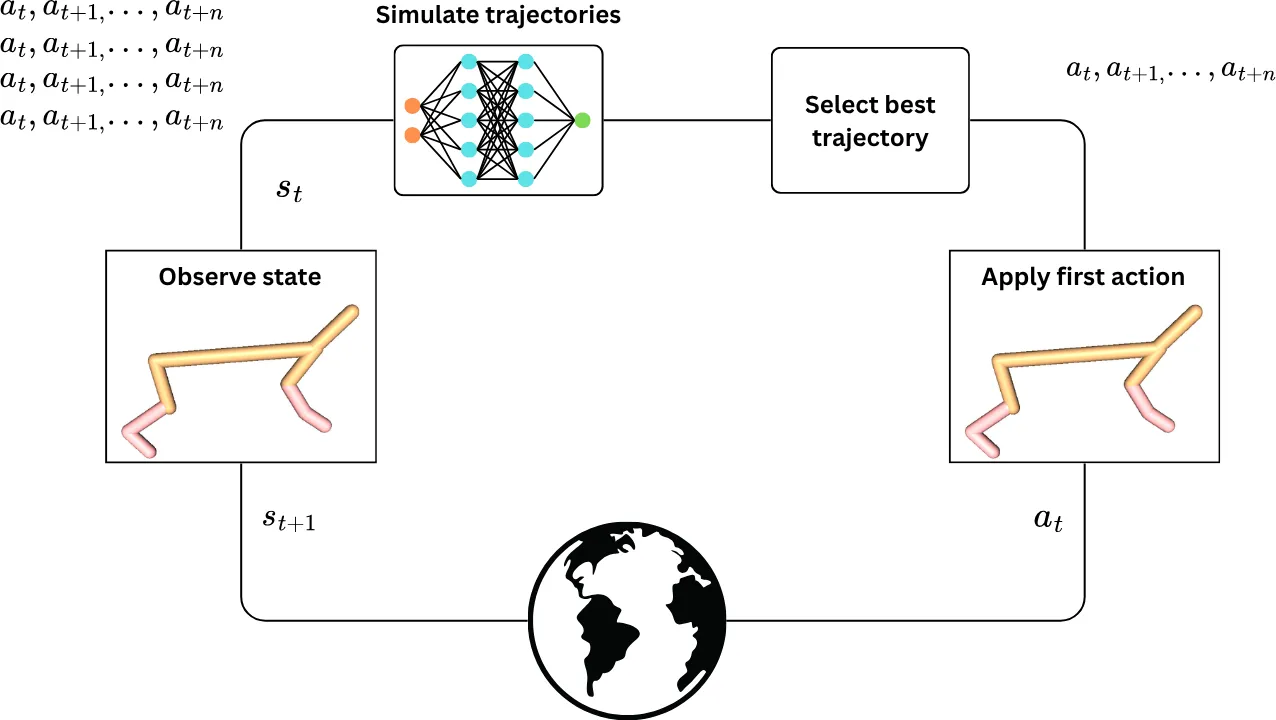
iCEM (Pinneri et al., CoRL 2020) is a sampling-based planner: at every step it simulates many candidate action sequences, keeps the best one and applies only its first action. MBiCEM runs it on a learned dynamics ensemble instead of a perfect simulator. A learned model can be confidently wrong, so simulated trajectories on which the ensemble members disagree strongly are heavily penalised.
- Reimplements iCEM and adapts it to learned models.
- Supports MBOP (Argenson et al., NeurIPS 2020) as an alternative planner.
- Explores ensembles of value functions and behaviour-cloned policies to guide planning.
Result
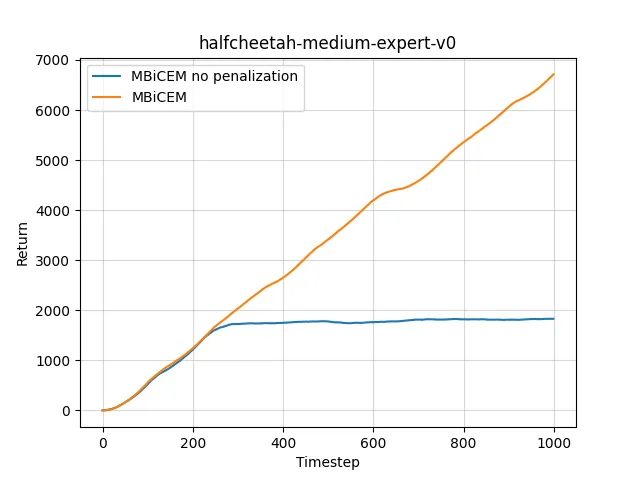
On halfcheetah-medium-expert, the uncertainty penalty is the difference between a planner that stalls and one that keeps improving throughout the episode.